

The Autonomic Nervous System, or ANS, is the part of the nervous system that regulates activities of internal organs. The ANS is largely autonomous, acting independently of the body’s consciousness and voluntary control. It has two main divisions:
sympathetic, nervous system, SNS and parasympathetic, nervous system, PSNS.
In situations that require alertness and energy, such as facing danger or doing physical activities, the ANS activates its sympathetic division to mobilize the body for action. This division increases cardiac output, accelerates respiratory rate, releases stored energy and dilates pupils. At the same time, it also inhibits body processes that are less important in emergencies, such as digestion and urination. On the other hand, during ordinary situations, the parasympathetic division conserves and restores. It slows heartbeats, decreases respiratory rate, stimulates digestion, removes waste and stores energy.
The sympathetic division is therefore known as the “fight or flight” response,
while the parasympathetic division is associated with the “rest and digest” state.
Despite having opposite effects on the same organ, the SNS and PSNS are not mutually exclusive. In most organs, both systems are simultaneously active, producing a background rate of activity called the “autonomic tone” – a balance between sympathetic and parasympathetic inputs. This balance shifts, like a sea-saw, one way or the other, in response to the body’s changing needs. Some organs, however, receive inputs from only one system. For example, the smooth muscles of blood vessels only receive sympathetic fibers, which keep them partially constricted and thus maintaining normal blood pressure. An increase in sympathetic firing rate causes further constriction and increases blood pressure, while a decrease in firing rate dilates blood vessels, lowering blood pressure.
The autonomic nerve pathways, from the control centers in the central nervous system to the target organs, are composed of 2 neurons, which meet and synapse in Autonomic ganglia. Accordingly, these neurons are called preganglionic and postganglionic.
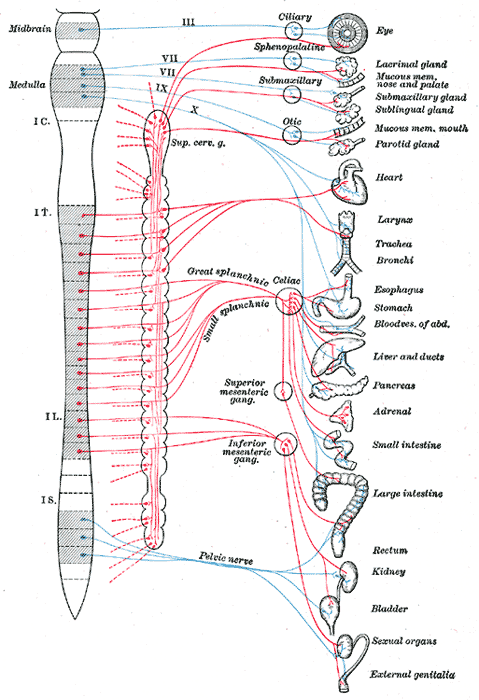
In the SNS, the preganglionic neurons arise from the thoracic and lumbar regions of the spinal cord; their fibers exit by way of spinal nerves to the nearby sympathetic chain of ganglia. Once in the chain, preganglionic fibers may follow any of 3 routes: some fibers synapse immediately with postganglionic neurons; some travel up or down the chain before synapsing; some pass through the chain without synapsing – this third group continues as splanchnic nerves to nearby collateral ganglia for synapsing instead. From the ganglia, long postganglionic fibers run all the way to target organs. The SNS has a high degree of neuronal divergence: one preganglionic fiber can synapse with up to 20 postganglionic neurons. Thus, effects of the SNS tend to be widespread.
In the PSNS, the preganglionic neurons arise from the brainstem and sacral region of the spinal cord. Preganglionic fibers exit the brainstem via several cranial nerves and exit the spinal cord via spinal nerves before forming the pelvic splanchnic nerves. Parasympathetic ganglia are located near or within target organs, so postganglionic fibers are relatively short. The degree of neuronal divergence in the PSNS is much lower than that of the SNS. Thus, the PSNS produces more specific, localized responses compared to the SNS.
You know that feeling you get when you’re anxious or scared or angry and you can feel your body start to spiral out of control almost like you’re falling out of a plane without a parachute well stick around because I want to tell you about the built-in emotional parachute that your body has and how you can deploy it whenever you feel the need.
This section is to let you know about your body’s natural and trainable counteracting response to the fight flight or freeze response. Anxiety isn’t just in our mind but it’s also very much manifested in our body; now there are a lot of things you can do to help pull yourself out of the, “fight or flight,” freeze response.
Here are four simple ways that I feel work best to calm you down and to soothe that anxiety response so we’re going to cover;
1. Deep breathing.
2. Peripheral vision and softening the eyes.
3. The valsalva maneuver.
4. The yawn.
But first let’s talk about a little biology for context so our bodies have what’s called the autonomic nervous system this part of our nervous system automatically regulates breathing heart rate, blood pressure and a whole bunch of other stuff when we experience a stressful situation the autonomic nervous system kicks on that fight, flight,freeze response which is also known as the sympathetic response this response is automatic and it controls how much cortisol and adrenaline are released into our system. It increases our blood pressure and our breathing rate; your hands may start to sweat, your stomach may clench up or your voice may start to shake just a little bit. These are the physical manifestations of anxiety.
However our brilliant, wise, beautiful body has a counterbalancing force called the parasympathetic response and that’s para as in parachute and this is the body’s natural way of slowing down and creating a sense of calm and safety.
So it works like this;
If your brain thinks that you’re in a dangerous situation whether that’s a tiger attacking you or just public speaking your body may trigger the fight flight freeze response, but when the dangerous situation is resolved and your brain knows that you’re safe your body then triggers this parasympathetic response which is also sometimes called, “rest and digest,” it’s called this because as your body starts to relax and transition from that fight, flight, freeze response other systems in your body which had temporarily been switched off; like digestion, these come back online and they start functioning normally again.
So your breathing automatically slows down your immune system turns back on and you’re able to relax, calm down, and your body has time to heal.
Now this is how your body naturally transitions between these two states and as i’ve said it’s all automatic so it may feel like this is all out of your control; but with some training you can actually teach yourself to kick on that parasympathetic response and to do that you first need to know about your vagus nerve.
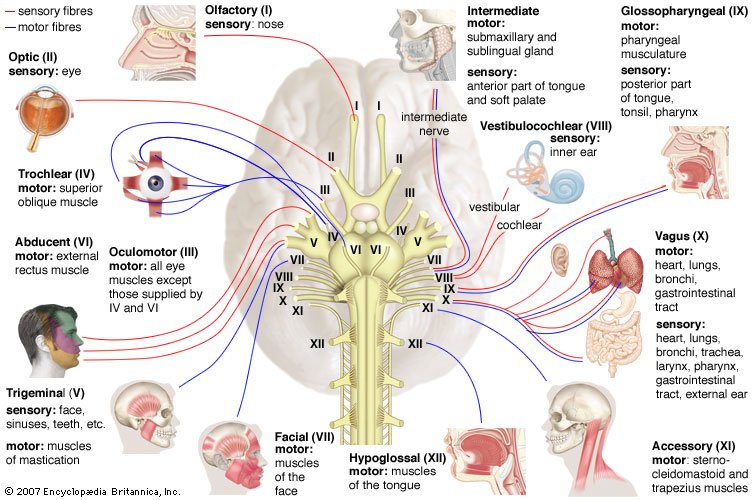
The vagus nerve is the longest nerve in the autonomic nervous system and this nerve does two really important things;
First it can trigger that parasympathetic response that we want, “rest & digest.”
Second it transmits signals in both directions so that means it can send information from your brain to your body, about whether to be stressed or calm.
Then it sends information from your body to your brain about whether to be stressed or calm.
So when we practice these bodily calming techniques we actually send a message along the vagus nerve from our body to our brain saying that things are okay that we’re safe and that in turn calms our stress and our anxiety.
So now let’s go over these four body calming techniques that will help you send these calming signals from your body to your brain and better help you regulate your emotions in stressful situations.
Let’s talk about vagal tone, vagel tone is a measure of how strong your parasympathetic response is, it indicates how good your Autonomic Nervous System (ANS) is at calming down. Just like muscle tone in your arm would indicate how much you exercise your arm vagel tone is a measure of how much you use you parasympathetic nervous system and how strong it is.
So to start first i’m going to tell you how to feel your vagel tone and you’ll be doing this by noticing your heart rate variability.
First find your pulse on your wrist or if you hold really still you should be able to feel your heart beating now close your eyes so you can focus and breathe in and breathe out very slowly, pay attention to what happens to your heart rate when you breathe in and when you breathe out.
Okay did you notice that when you breathe in your heart rate increases and when you breathe out slowly your heart slows down that is heart rate variability.
For people who have a stronger vagal tone their heart rate slows down even more on the out breath than people who have a weaker vagal tone and just like exercising your arm muscles you can exercise with deep breathing to strengthen your vagal tone.
Higher vagal tone is associated with better general health, it leads to better blood sugar regulation, better heart health, improved digestion and a reduction in migraines; most importantly it improves emotional stability and resilience.
Lower vagal tone is associated with mood instability, depression, PTSD, diabetes, chronic fatigue syndrome, cognitive impairment and inflammation.
Deep breathing
So you’ve probably heard that deep breathing helps with stress and anxiety and this is why deep slow breathing helps to increase your vagal tone and trigger that parasympathetic response through the vagus nerve. You may feel yourself relax when you do it, you may notice that you start to salivate or that your eyes may soften and that’s all thanks to how deep breathing and vagal tone affect that vagus nerve.
So practicing deep breathing and especially those long slow out breaths can help you soothe that stress response. It can train your body to be better at kicking on that calming parasympathetic response. So deep breathing is a really helpful skill for people with anxiety disorders and PTSD.
So I just mentioned that your eyes soften when you do deep breaths I don’t mean that they become squishy or something like that but rather that they lose focus on any one particular thing they relax and your focus shifts from a specific visual point to more of your peripheral vision and everything around you. So you’ve likely experienced eye softening when you’ve been lost in thought or daydreaming; your eyes are open but they’re not really looking at anything and this is what I mean when I say your eyes soften.
Now these nerves here three and seven from the parasympathetic system these control our eyes. You have maybe heard of the term tunnel vision? That’s where your vision seems to get really narrow when you’re stressed and again your brain is sending signals along that vagus nerve to get into that fight,flight, freeze response.
Well it turns out that tunnel vision is a sympathetic response and again that’s part of the fight, flight, freeze and when we soften our eyes we can trigger a parasympathetic response meaning we can use our body to send signals up the vagus nerve to the brain and tell it to calm down.
Now buddhists and yogis have known and practiced this for centuries.
Peripheral vision and softening the eyes
So here’s the second way to trigger that parasympathetic response;
So start by softening the muscles around your eyes; so if you don’t know how to consciously do that you can start by squeezing them shut and then consciously like relaxing them to gain more awareness or you can just gently touch the side of your eyes, you can gently close your eyes and then open them really softly.
Try to expand your awareness out to the sides of your vision while keeping your eyeballs straight ahead so you can keep looking at the screen but then just start to notice what’s out to the side and using that peripheral vision is a way to trigger that calming parasympathetic response.
Valsalva Maneuver.
A third way to calm anxiety is to increase the pressure in your chest cavity this is called the valsalva maneuver.
You can plug your nose and close your mouth and push out as if you’re gonna exhale or like you’re going to you stifle a sneeze.
The vagus nerve actually comes into contact with your pelvic floor;
Sit down or lie down.
Take a deep breath and hold it.
Pinch your nose shut.
Close your mouth.
Bear down hard, as if you’re trying to go to the bathroom.
While you’re bearing down, breathe out like you’re trying to blow up a balloon or stifalling a sneaze.
Strain hard for about 10 to 15 seconds.
If it doesn’t work, wait for at least a minute before you try again.
Bearing down is another way to stimulate that nerve and to send signals to your brain to calm down. To trigger that parasympathetic response try;
Breathing in for five seconds, then hold it and bear down for five seconds (contract the abdominal muscles and the diaphragm.) now you don’t need to push hard you just need to create a little pressure in your chest and then finally breathe out for five seconds. Do this once or twice in a row breathing regularly in between so you don’t get light headed and this can help trigger that vagus nerve.
Yawn
Finally the fourth action to trigger that vagus nerve is to yawn so my favorite way to do this is to make the R sound, open your mouth really big and try to lift your soft palate in the back of the roof of your mouth there’s a decent chance that this is going to make you yawn. Or you can even try a fake yawn to trigger that response, this action makes me sleepy and relaxed almost everytime.
Have you ever noticed how if a dog gets super hyper they’ll start doing these huge dog yawns as they calm down.
You know how yawns are contagious well that’s because yawning is actually a herd behavior. These contagious yawns keep the pack from going wild with excitement. these yawns send a message between dogs to each of these animals vagus nerves to say, “chill out calm down, you’re okay.”
So those four quick ways to trigger the parasympathetic response but there are a bunch of other techniques to try.
Learning to turn on that parasympathetic response could be a great skill to have when dealing with anxiety disorders, PTSD depression, and stress, if you are at your desk just take five minutes out of your day and do some slow steady breathing. If you know someone who could benefit from these skills please share this blog.
 A better way