

Today I want to talk about the most devastating disease in the world. It claims many times more lives than cancer and most people who have it don’t even know it.
We’re going to talk about how it does its damage?
Why it is so poorly understood?
How you can protect yourself?
This disease because it’s directly linked to all those mechanisms, it further causes these diseases.
- It causes cardiovascular disease.
- Heart disease.
- It causes strokes.
- It causes dementia.
- It causes kidney failure.
- Is the leading cause of kidney failure.
- Blindness.
- Amputations.
- It further contributes to cancer.
- It interferes with the body’s ability to defend itself against cancer
- If you have a serious infection it increases the risk of you dying from that infection.
All in all it’s been estimated that this disease is involved in over 95% of all the generative diseases.
What is this mysterious disease?
It is insulin resistance.
For some of you, you go,
“Wow! Insulin resistance I had no idea?”
Others are going to go,
“What? Just insulin resistance?”
To understand what insulin resistance is, it is the most devastating disease we have ever had on the planet and it is the most costly both in financial terms, human suffering and then someone might say,
“Well you have to die of something all those diseases you listed they’re just old people diseases.”
True but it is also a matter of dying longer because with insulin resistance and all those degenerative diseases people spend 10, 20, 30 years dying during that time they suffer tremendously more than a healthy person and their quality of life suffers.
During all that time they can’t do the things that they want to do they’re on medication they need help and so forth so it’s about the quality of life in terms of energy, mood productivity all those things that make life worthwhile; then of course on top of all that it is also causing more deaths than anything else if we looked at some of Deadliest diseases;
- Around the world we have;
- Cancer at 9.5 million
- Heart disease 17.9 million
- Hypertension 7.5 million
- Stroke 5 million
- Diabetes 4.2 million
One of the biggest misconceptions about diabetes and insulin resistance is that you either have it or you don’t; but in fact it’s just a matter of how much of it do you have.
Where are you on the continuum?
The continuum goes all the way from diabetes to prediabetes to optimal diabetes is.
They have to draw the line in the sand somewhere so they decided that when your hemoglobin A1c when your long-term average glucose is 6.5 or higher, corresponding to an average glucose level of 140 mg per deciliter then they say now you are diabetic, now you have the diagnosis of a diabetic and you could go a whole lot higher than 6.5, people have 10 and 12 and 15 also when they’re diabetic.
They diagnose you as pre-diabetic if your hemoglobin A1C is between 5.7 and 6.4 and if you are pre-diabetic then they expect you the average pre-diabetic will become diabetic in 5 years.
At the other end of the spectrum is optimal and optimal A1C is 4.8 to 5.1. Mainstream medicine thinks that 5.3 to 5.6 is still perfectly okay because you’re not 5.7 yet or 6.5 yet but here’s the thing to understand that if you are not optimal if you are in the 5.3 to 5.6 range then you are slipping, you are on your way towards more insulin resistance.
Because if your insulin sensitive then you are stable you’re leading a lifestyle that you can maintain and your body isn’t moving away from there but if you’re moving away from there then it’s just a matter of time and how quickly you’re going to get there. So that’s why we want to pay serious attention listen to anything 5.3 or up.
Then we look at the prevalence how common is this?
In the UK 1 in 15 people have diabetes that’s 4.7 million.
1 Million of that number have type 2 diabetes don’t even know.
30 million people in the United States have type 2 diabetes.
Around the world it’s 463 million people with type 2 diabetes.
They’re expecting that to double in the next two to three to four decades.
Somewhere around a billion and when we look at the people who are slipping we’re probably talking about 300 million people in the US and probably at least 2.2 billion people around the globe.
Why do we say that?
Because insulin resistance is the primary cause of weight gain and we have over seventy percent of the US population is overweight and more than a third of the world or around a third of the world is overweight today.
Here is how the numbers of obesity have progressed in the United States from;
1800 where it was virtually non-existent.
1900 started happening but then,
1960 post-war and on it has been an exponential growth.
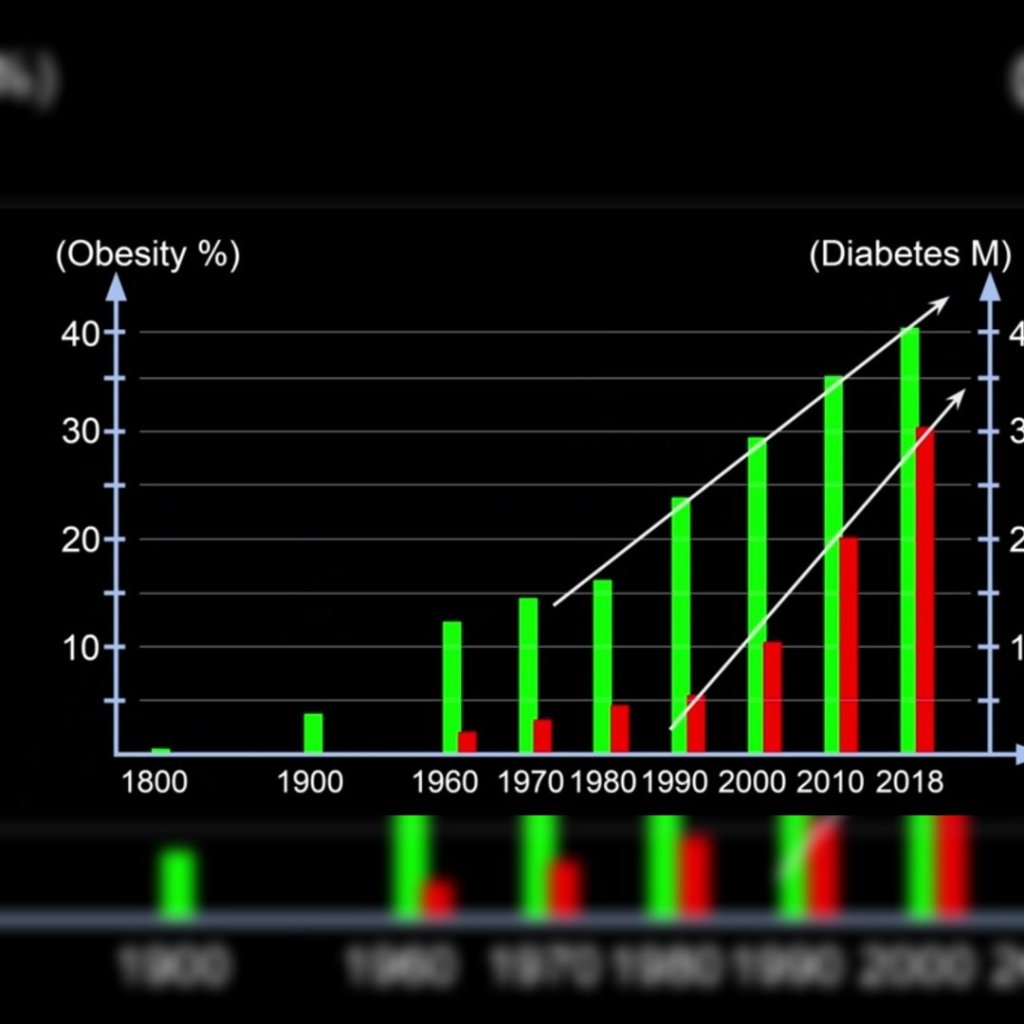
Explosive exponential growth 1960’s and the reason is that it takes a few decades.
We talked about how it takes five years to get from insulin resistance to full-blown diabetes.
It probably takes 15-20 years to get from very mild insulin resistance to diabetes so there’s about a 15-20 years and while the United States is the world leader among large countries in terms of diabetes obesity and overweight.
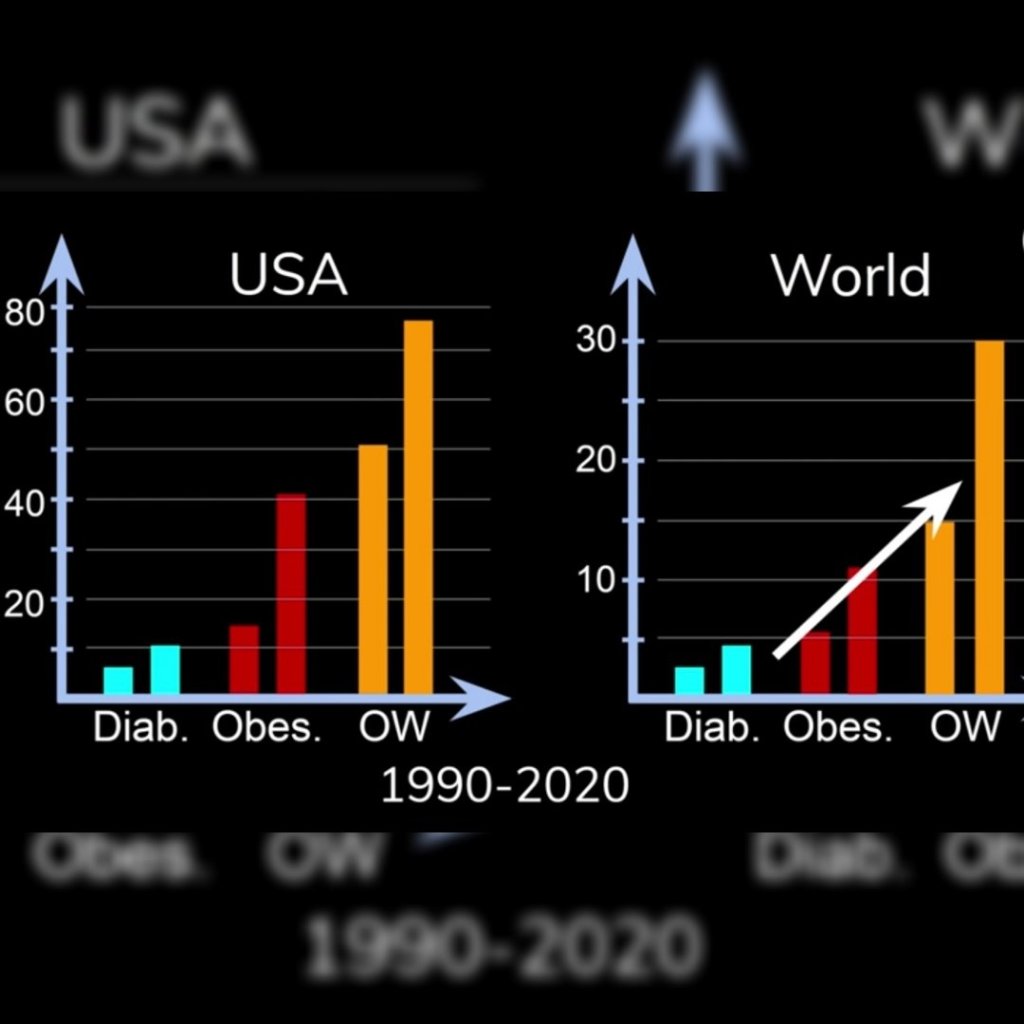
This is how it’s progressed from 1990 to 2020 the rest of the world is only a matter of time how far they’re behind because the tendency is exactly the same so we want to talk about how to fix this.
What Does Insulin Do?
But first we have to understand what does insulin do?
Where does insulin resistance come from?
When you eat food it gets in your digestive tract which digests the food and breaks it down into smaller particles and then once the particles are down to molecular size they get absorbed into the bloodstream; but they can’t get from the blood to the cell without insulin.

That’s the job of insulin.
That’s why insulin is absolutely necessary.
Type 1 diabetics who can’t make insulin if not diagnosed and treated will die because they have nutrients in the blood but they can’t get to the cell. So insulin is not a bad thing but it’s all about balance.
One of the biggest reasons insulin resistance is such a big problem is that it’s so poorly or incompletely misunderstood; if you look it up online then you will see that insulin resistance is when cells in the body such as muscle fat and liver they stopped responding. They don’t respond well to insulin. But the question is.
Why? When you hear a statement that the cell isn’t responding well then why is it just arbitrary that the cell is just being stupid? Or does the cell have a really, really good reason for starting to resist insulin?
The body is infinitely smart, every cell in the body is attempting to return to homeostasis (balance) everything is flowing according to an intelligence in the body. So there’s always a perfectly good reason why the body does what it does. What if we don’t understand?!
That if we think that the cell is arbitrarily stupid and one day it responded and the next day it doesn’t respond to insulin.
Then we might try to force it anyway and that’s called medication.
So if the cell doesn’t want what the insulin is providing, if the cell says,
“Oh I’ve had enough!” The cell says,
“I’m starting to resist!”
But we force it.
Now the question is.
Do you think that we’re moving that cell closer to health or away from health?
Are we improving the health of that cell by violating its wishes?
Or are we actually hurting that cell?
I think it’s pretty clear that when you force it when you try to interfere with what the body is doing; sort of impose your will.
Let’s look at it one more way about insulin resistance.
What would you do?
Let’s say your house is the cell and then one day a salesman (insulin) shows up and it was a really long time since you had someone knock on your door, so you’re all excited to go and open the door.
You ask the salesman,
“Hey what you got there? that looks really interesting.
You appreciate the visit and you have an exchange of information and maybe you buy something.
so that’s all good; but what if he shows up again, after he completed the sale he shows up again five minutes later!
Now you go,
“Hey what’s going on here?” You’re a little suspicious, you’re starting to hesitate a little bit and then what if he shows up every 5 minutes for the next several days!!
Then I think you would get a little bit upset, you would tell him to get lost. You would start to resist that sales person.
Same thing with telephone cold calling, I don’t know about you but 90% of the time the phone rings; it is a computer calling me with some fabulous offer of credit or car insurance. I have to admit after so many of those calls you hang up you block the number and then 30 minutes later the same computer calls on a different number so I don’t respond. Now I’m starting to resist those telephone calls and that’s exactly what’s happening to the cell when the insulin is trying to overdo it.
When there’s too much insulin then we start resisting it.
So insulin resistance is resistance to the action of insulin and when your cell starts to resist that action of insulin, that’s a physiological adaptation, the cell is trying to return to balance (homeostasis).
Have you noticed how fat tends to get blamed for everything?
That’s because nobody wants excess fat on their body, it is unhealthy and it’s burdensome It’s kind of in the way, it’s heavy lugging it around, people don’t like excess fat on the body.
But is it the root cause if you have a lot of fat?
It is because you have too much fat storing and you don’t have enough metabolism, you’re not burning enough of it off. That in turn depends on increased lipogenesis it’s not just what you’re eating in terms of bad it is how much fat is your body making, that’s what lipogenesis making fat and if you don’t have much of a metabolism then you’re not breaking down the fat enough, so you have decreased lipolysis and both of those are a direct result of insulin resistance.
because the more insulin resistance you have the more insulin the body is going to try to make, to control blood sugar so insulin goes up but insulin is only the result of blood and now here is the root cause the blood sugar is a result of sugar and starch.
Fat is not the cause
Everybody blames it on fat but the fat is not the cause it’s the end result the cause is sugar, starch, blood sugar and insulin.
How can we be so certain of that? Because we know what causes insulin responses, if we put an index value of a hundred on sugar and starch than protein produces about half as much of an insulin response and fat produces virtually zero it’s in the single digits.
Furthermore protein and fats are very satiating. They keep you full for a long time, but sugar and starch makes you hungry. But some people are still not convinced because there’s some studies that say that fat cells are more insulin resistant. When we measure the signaling molecules from fat cells and how fat cells behave there more insulin resistant so the fat must be the problem.
Well, it may look like that but the fat didn’t make the fat cells fat the insulin did. It’s really sad; it’s just like when we’re shaming the fat we’re blaming people with excess fat for being lazy and gluttonous. Well now we’re blaming the fat cells we’re shaming the fat cells,
“bad fat cells you shouldn’t be insulin resistant,” well we made it fat with insulin because there’s,
- The sugar starch that causes
- The insulin that causes.
- The fast storing.
Now we have the end result is a fat, insulin resistant fat cell that we can shame; just like we shame people with excess fat.
I think those are pretty convincing arguments and the experience of a lot of people who are doing fasting and ketosis and low carb are having excellent results.
You would think that the information would get out but when we check with the World Health Organization (WHO) about the cause of obesity they say,
That it’s too many calories, it’s an increase in calories, people are eating more calories from fat and sugar than they did in the past. They are less active.
So what do they suggest that we do about it?
Well they say reduce the calories from fat and sugar.
Now, they’re 50% right and they’re 50% absolutely wrong because the fat is not the problem” unless you’re eating poor-quality fat.

The sugar is an enormous problem, it is the primary problem.so when they say to reduce the calories from sugar that’s the right thing to do. not the fat but then they say increase calories from fruit,vegetables, beans and Grain, vegetables are totally okay if you’re eatin non-starchy vegetables, leafy greens, cauliflower Etc. But basically what they’re saying here is reduce calories from fat and carbohydrates and increase calories from carbohydrates, carbohydrates, carbohydrates and carbohydrates.
That is how you go from insulin resistant to diabetic.
So what can the healthcare system do about this devastating disease?
In the United States in 2020 they will spend over 4 trillion dollars on so called “health care” I put that in quotation marks because it’s not healthcare it’s sick care, it’s symptom treatment and they’re spending over $12,000 per person and that’s average out on the people without so many problems also. But despite all that money spent more money than anywhere else in the world they have
- More diabetes
- More heart disease
- More arthritis
- More high blood pressure
- More metabolic syndrome
Than they’ve ever had before and as time goes they spend more money and the diseases become more prevalent.
Why is that?
Because the treatment is for symptoms only not the root cause. They don’t understand the root cause, they’re not interested in the root cause, they’re interested in treating symptoms.
Do you need more reasons to reverse insulin resistance?
Well there was a recent virus that I got a lot of people’s attention it’s called the coronavirus and the interesting thing is that there’s certain risk groups that have very,very low risk and their other risk groups that have very,very, high risk and other than age, insulin resistance is the primary factor in the biggest factor in age is that more elderly people are more insulin resistant. But from these low to the high-risk groups that can be a hundred fold difference in death rates; a hundredfold hundred times more likely to die if you have a high risk than if you’re in a low-risk. That’s pretty substantial and virtually all the risk factors identified outside of specifically age have to do with insulin resistance.
We have to understand that pathogens are opportunistic; they take advantage of a weakened host, that’s why they can be a hundredfold difference.
So what to do about Insulin Resistance?
Now we’re ready to talk about what to do.
But why couldn’t we just go straight to that?
Why couldn’t we just list out the things to do?
Give me the bottom line?
Because if we don’t have the reasons if we don’t understand the depth of the devastation. If we don’t understand the scope of the problem and the mechanism then we’ll take that final list and we’ll try it.
You know what try means?
That means we’re absolutely no way we’re going to go through with it, we are going to try it for a few weeks and then we’ll be back to doing what we did before. Once that starts sinking in then it starts making sense and you can make changes for life.
Prevention is easy, it’s about insulin not calories. It’s not how many calories you eat it’s what sort of foods trigger insulin. Because those foods will make you eat more and trigger more insulin and so on and so on.
The simplest rule of all when it comes to diet is eat real food.
That’s it. Eat it the way nature make made it eat single-ingredient foods put it together yourself as much as possible and avoid fake food.
Don’t eat fake food
Don’t eat processed food.
Packaged foods foods with additives and 37 ingredients
Because man-made food isn’t food, it looks like food, it almost taste like food sometimes, but it doesn’t nourish your body. It interferes with it, throws things out of balance.
The biggest reason fake food hurts you is that a lot of it is full of sugar and fructose especially and it also is full of processed starch, then there’s a ton of other things they throw in there like MSG,artificial flavours, preservatives, chemicals and colours and all that.
But if you are insulin sensitive. If you are in balance then this is basically all you have to do to prevent insulin resistance.
If you already are insulin resistant now you need to reverse it and that’s not quite as easy but it’s still simple.
You just need to do all of these steps above. It’s the same rules but you have to add a couple of more and do all the above, plus you go on a low carb / keto diet. you have to go lower in carbohydrates than someone is just trying to prevent it, because you’re already many years or even decades into the process, into the physiological adaptation of pushing that sell toward insulin resistance.
The second powerful tool in addition to low carb it’s not one or the other you want to do both is intermittent fasting you eat less than 6 meals a day and then you go to three meals and then you go to the one or two meals and you figure out where you’re going to get the results.
 A better way